-
The Last Squeeze
My kid loves pouches.
In spite of every effort to encourage varied eating and a balanced diet of diverse foods, nothing lights him up quite like eating a pouch. Sometimes it’s the only way I can get him to do something – and yes, I am not above bribery especially when sneaky fiber is involved.
The older he gets, the more independent he is when it comes to every aspect of life, including eating said-pouches. He insists on holding them and twisting the cap off, and holding the cap because heaven forbid the cap gets lost… cue: meltdown. I’m cool with all of this, but the one thing that drives me truly crazy is if he hands me back a pouch with food (smoothie? mush? what is even in a pouch?) left still in it. I’m usually not one to coax around food – my policy is if he says he’s done, he’s done, no questions asked. But something about that last little slurp in a pouch going to waste drives me bonkers… maybe because I already have so much guilt around the amount of single-use plastic involved in feeding kids, in general. But, I digress.
I recently found myself calling the last bit of pouch “The Last Squeeze”, and for whatever reason it has stuck. Now Max knows to ask for my help getting out The Last Squeeze as my obsession with avoiding waste has rubbed off. The more we work together to troubleshoot The Last Squeeze – him sucking out every last drop as I roll up the bottom of the pouch plastic to push all of the mush to the top – the more I’m inspired by this metaphor for life in general. To me, The Last Squeeze represents the little morsels we forget about or leave on the table, the driblets of experience or insight or connection we give up on and leave by the wayside. That Last Squeeze takes effort and coordination and determination – and sometimes, a little help from a friend (or in Max’s case, Mama).
The Last Squeeze reminds me of a mantra I hold dear, a mantra that came to me during the darkest days of Covid pandemic uncertainty: “this is part of my full human experience”.
This is part of my Full. Human. Experience.
Not my Perfect human experience, or Happy human experience – full human experience. We deserve to feel things and encounter things as varied and diverse as an aspirational toddler’s food palette, pouch included… and The Last Squeeze is one way to chase that full human experience so it doesn’t just happen to us, but rather for us and through us. It makes me wonder what metaphorical pouch slurps I’ve left behind along the way, and it inspires me to soak up every last drop, even if the parenting-flavor-of-the-day isn’t my favorite.
—-
Earlier this week, Max had a meltdown as we were getting ready to eat dinner which happens more often than not. Mealtime transitions – heck, all transitions – are hard for him. I don’t remember the specifics, but he probably was asking for a pouch, yet again, and I was probably telling him that pouches are not on the menu for dinner, yet again (in this instance I decided against pouch-bribery, apparently). It’s a script we play out often, can’t you tell?!
His crying was starting to escalate and I was starting to tune it out a bit to get through the rest of the evening routine without having a meltdown myself, but he did something that totally surprised me: through his wailing tears he said “I want the Calm Song”. I had never heard of this song before – I assumed it was something they play at school – so I started searching for “The Calm Song” in Spotify and went through the list of songs that popped up. After sifting through three or four different “calm songs”, we got to one called “Deep Breath” on a kid’s album, Gracie’s Corner. He nodded vigorously – “yes, that one” as we let it continue to play. He settled down; sucked his thumb for a few minutes; and eventually said he was ready to go in his high chair to eat. I was so proud of him for knowing listening to music would help him feel better, and for asking for what he needed even at the height of a tantrum.
The next morning I excitedly shared this with his teachers, reflecting on how incredible it is that something he learned at school is translating to his home life too; that he’s remembering something from a different setting and applying it to our time at home.
His teacher shook her head and said “I’ve never heard of that song before… we don’t play anything like a calm song, he didn’t get it from us!”.
My Max. My wise, articulate, intelligent boy. He somehow came up with it all on his own, knowing intuitively that music would make him feel better and that “calm” was the feeling he was after. Maybe the months we spent in dance class together or the countless moments we spend having “dance parties” around the kitchen have sunk in in this way; maybe seeing us take deep breaths ourselves as we try to keep it together when we’re reaching a breaking point has left an impression on him. Either way, this was a reminder that every Last Squeeze is worth it.
-
Milestones in the Monotony
It’s easy to get caught up in the monotony of motherhood, so I cling to moments marked that unexpectedly turn into milestones, even when I least expect it.
This morning as we were waiting in the lobby of the outpatient center for Max’s physical therapist Danielle to come and get him for his session, I expected the hand off to be the same as it always has been since we started this physical therapy journey a year and a half ago: “any updates? anything you’ve been wanting to work on? how are things going at home?” Physical therapy has been a regular part of our weekly routine since Max was born, because he has had some gross motor delays due to his premature birth. These PT appointments have become such an important part of our week, something to look forward to and celebrate because PT is where so much of his growth has happened. If I’m honest, they’ve also been a bit of a reprieve, an hour in my week when I can hand him off to a trained expert who is giving him dedicated one on one time while I can take a break from being in charge of his care.
When Max was an infant, our focus at PT was on tummy time and rolling. Then we worked on sitting, then crawling, then pulling to standing, and eventually walking. As expected, he hit most of these “milestones” months after his full-term-peers; it was hard to not worry about him being left behind, being the only kid in his class who scooted on his butt like a goofball when the other kids were crawling, or who crawled when all of the other kids were walking. With every delayed milestone, he eventually caught up though. He tackled each one in his own time, in his own way, like he always had since the beginning.
Looking at him now as the little boy who walks and climbs and dances, you might never know he had a different journey than any other kid – you might not notice the little ankle braces that stick out above the top of his shoes to help steady him, or the extra bumps and bruises he gets on his noggin from losing his balance and falling into things. Even I forget it sometimes – even I take for granted that he can climb down off of the couch on his own to pick out a book, or that he can walk to his toy bin to put his toys away.
But today’s physical therapy appointment has made me think back on all of his progress, because unlike other mornings, this morning our physical therapist Danielle began her greeting with “so, today’s our last session!” I knew it was coming eventually because Max is basically “caught up” – he has been for a few weeks now, fully mastering walking which was the latest milestone we had been working on. But at the same time, it seems surreal that something we’ve prioritized and put so much effort into these last 20 months is just… coming to an end.
I am so incredibly proud of Max and all of the work he has put into his PT. I am proud of myself for remaining committed to Max getting the best care possible, even when it was a total drag to sit in traffic to make it to the appointments on time or practice our PT homework at the end of a long day.
I’m also reminded of the fear and uncertainty we faced at the beginning of this journey when Max was first born – when we were first told that he could have developmental delays due to his premature birth. We had no idea then what those delays would entail, how they would affect him physically or intellectually – and at times, surmounting them has felt near impossible. But consistency and commitment has paid off, and once again we are suddenly on the other side of that fear which is also remarkable – we have made it to the “finish line”, or at least this finish line. When Max’s potential delays were explained to us, we were told that “premature kids usually catch up with full term kids by the time they turn 2”, so he’s actually even ahead of schedule by that standard. Surely, he will continue to struggle and encounter challenges like every human being does in their lifetime, but PT coming to an end somehow provides a sense of unexpected relief that his delays from pre-maturity weren’t… worse. It’s like I didn’t realize I’ve been holding my breath about this until I could finally let myself exhale today. And I know that all of the resilience he has built during his time at PT will carry over into every aspect of his life, even if he won’t consciously remember this time in his life.
Physical therapy has given us so many gifts – the gift of rolling, crawling, standing, and walking, but also the gift of knowing that challenging times DO come to an end. That during this crazy ride of parenting, there ARE moments of closure and satisfaction and accomplishment, even if we just go on to face the next big hurdle. On a personal note, it has given me a sense of comradery and community as I sat in the lobby of that outpatient center each week with the other parents of children with developmental delays, some more extreme than others. It gave me a sense of connection with at least one other kindred-spirit mom, Danielle, who shared so much of herself with us during our time working with her. It gave me someone to celebrate his growth with, someone who was as personally invested in his advancement as I was. It has exposed me to one of the best gifts of parenting that I didn’t even know existed: seeing someone else who cares about your child cheering them on, rooting for them, and helping them along their journey.
It is true that raising a child takes a village, and I am so grateful to have had an amazing physical therapist in ours.
-
The Power of Asking The Right Kinds of Questions
“What other questions do you have for me?”
I was sitting in the Maternal Fetal Medicine doctor’s office after one of our many bi-weekly appointments. I had been referred to him by my regular OBGYN when she noticed that my baby’s growth had become restricted at around 20 weeks of pregnancy. Between the ultrasounds and blood draws involved in a “normal, healthy” pregnancy and all of the additional appointments for my now-at-risk pregnancy, information was swimming around me at a whirlwind pace. This appointment felt different though – this doctor felt different. Instead of rushing out of the room after giving me his update, he pulled up a chair and sat with me. Instead of giving me a high level summary in layman’s terms about what was going on with me medically, he pulled out a pen and paper and drew flow charts to help me understand the science behind my condition. Instead of asking me “DO you have any questions” – he asked “what other questions do you have for me?”
It’s a subtle but powerful shift – the former would have put the burden on me to say “yes, I do”, to ask for the opportunity to ask more questions. The latter came from a place of curiosity, of assuming I would have questions and reinforcing the doctor’s role as the individual uniquely positioned to add value. At a time with so much uncertainty, my doctor asking me a very common question in an open ended way took some of the emotional burden off of my shoulders and signaled to me that he was here TO answer my questions no matter how many there were or how long it would take.
—
A few months later my son Max was born – 7 weeks early and with some growth/feeding challenges, but otherwise healthy. In the months that have passed, I have gained some much needed distance from a lot of the trauma baked into his birth, his stay in the NICU, and his transition home. One reality that lingers, though, is that Max continues to develop at his own pace. This is to be expected given how early he was born, but doesn’t get any easier. With each new developmental milestone – rolling, sitting, crawling, walking – we have a new reminder of Max’s delays and what caused them in the first place, his early birth.
What’s even harder to deal with than his delays is having to talk about his delays, especially with well-meaning loved ones inquiring after his health.
“Is Max just crawling up a storm these days?”
“Is Max walking yet? He’s about at that age!”
“Is Max eating solid foods? He must be a good eater!”
Any and every bodily function is apparently up for discussion. I’m grateful for the curiosity and interest, but every time I am asked one of those questions – a close-ended question with a yes or no answer – I am put into a position to acknowledge his deficits, comfort the concern of the person asking, and explain everything we’re doing to work on it to almost convince them that we’re on top of it.
“Is Max just crawling up a storm these days?” – no, he doesn’t crawl yet… he scoots on his butt which is actually super adorable. Some doctors even say that lots of babies skip crawling but we’re still trying to make it happen
“Is Max walking yet?” – he’s getting close! We’re in Physical Therapy twice a week to work on it and he’s getting fitted for ankle braces next week.
“Is Max eating solid foods? He must be a good eater!” – he is eating solid foods, but we’re taking things slow. He still has some swallowing sensitivity so our Feeding Therapist is guiding us through how to expose him to different foods and textures.
The more I hear these types of questions, the more I understand the value of asking open-ended questions – to new parents, yes, but to anyone in general.
Asking open ended questions gives the person answering the opportunity to decide what to share, and to set the tone for the conversation. It requires the person asking to stay curious instead of projecting their own expectations or assumptions onto the situation.
When we ask open-ended questions, we leave ourselves open to discovering new possibilities and allow ourselves to define our own truth.
In terms of parenting, all of this could be solved with the subtle reframe: “what is Max doing these days?”, or even better – “how is Max?” and “why do you think that is?”
Talking to new parents poses a powerful opportunity for us to practice asking open-ended questions, so we can translate that skill to conversations we have in every area of our lives.
More importantly, asking open-ended questions gives us the opportunity to empower others to make meaning for themselves; and it gives us the opportunity in turn to bear witness to that meaning further enhancing our own value.
-
Milk Trade: Chronicles of the Breastmilk Black Market
#normalizebreastfeeding
#freethenipple
Now that we’ve gotten that out of the way: I have recently found myself in the bowels of the dark web…. Well, maybe not quite the dark web per se, more like obscure Facebook groups about the breastmilk black market. In the early days of Max’s life, I built up quite a stash of frozen breastmilk because I was pumping like a fiend to “keep my supply up” – something every pregnancy, labor and delivery, and neonatal care professional emphasizes with a twinge of fear in their eyes. I always found it sort of strange how much collective despair and anxiety there is around not being able to produce enough breastmilk – I mean, what even is “enough”? And how do you know what’s enough if your baby isn’t even with you to drink it, if your baby doesn’t even know how to drink yet?
So I dutifully pumped, and Max grew in the NICU, and we eventually learned how to nurse, and when Max came home from the hospital I bought an extra freezer for my garage to store the hundreds of ounces of extra milk I had produced during our time apart. Since being together, it’s been out of sight out of mind. My milk production has regulated thanks to lots of patience, persistence, and good ole’ breastfeeding Max. Now I know I produce enough, because Max is here to define what enough is instead of that being decided by a machine.
That still leaves us with the freezer full of breastmilk. A stash that unfortunately has an expiration date. A stash that we probably couldn’t use up before it goes bad even if we tried. I’ve joked about what to do with it to put it to use: give baggies of breastmilk away at Halloween! Hand them out as favors when people come to visit us! Donate it to an animal shelter to feed orphaned kittens and puppies! (I actually did look into this and it turns out other species don’t drink human breastmilk because it’s too watery for them… the more you know). I could hypothetically use it to make lotions or soaps for Max, but I am not that crunchy, and the idea of just throwing it out pains me – each of the 100 or so bags in there represents at least an hour of my time pumping, cleaning pump parts, measuring, storing, and labeling. As much as I’d like to gift it all to a NICU to pay it forward in honor of the donors who supplied Max with milk in his early days, I ironically don’t qualify because of medications I am on to manage the high blood pressure which put Max in the NICU in the first place.
That is how I ended up on the breastmilk black market. There are Facebook groups of parents out there connecting people who need breastmilk with people who have breastmilk to give. The group I first found is specifically for people in Tennessee. I did some scrolling through old posts to get a sense of what the deal was, and then put myself out there with a post saying I have a stash of breastmilk in the Memphis area to give to someone who needs it.
Within hours, I got multiple direct messages from other moms pleading to be the recipient of my supply. I could sense the desperation in their messages, hoping for some relief from whatever circumstances disabled them from having their own breastmilk to give to their babies. My heart broke for them because I know all too well what it feels like to not be able to give your baby what they need to literally survive. I also felt proud to be among such fierce, dedicated moms – some of whom were willing to drive over 9 hours from the other side of the state just to pick up the milk I had to share. It’s breathtaking to encounter what parents – and in this case, mothers – will do to make things happen when left to their own devices. No official milk bank, no problem; leave it to moms with an internet connection and social media to feed the babies of Tennessee.
However, as I continued fielding inquiries and making arrangements to meet up with some grateful parents, I started to panic. What if we actually DID need all of this breastmilk? What if I stopped being able to produce enough milk for Max like so many of these other women experienced? What had once been a burdensome supply of frozen breastmilk started to feel valuable to me in a whole different way – just because it was now valuable to someone else. Instead of feeling grateful for what I had and what my body is able to do, I took on the pervasive fear and worry rampant in the breastfeeding space. I felt the need to hoard what I had, instead of giving it away to someone who needed it more than me. I immediately recognized this for what it was: scarcity mindset.
I was letting someone else’s sense of need define my own, and frankly it felt gross. It felt like I had given away my power, allowing random strangers on the internet to define my sense of what is valuable to me instead of assigning value based on the context of my actual life circumstances. I never had a supply issue before then; Max has the same number of feedings with the same amount of milk every day; I still have a small stash of milk to keep for myself if something happened to change; I have the time and resources to get help if my milk production happens to go down. Even though the easiest thing for me to do would be to keep the milk for myself, what is easy isn’t always what’s right.
In the coming weeks, I have plans to meet up with four different women who are each getting a portion of my frozen stash. One from Kentucky who is adopting a baby due in February after her own struggle to conceive. One from Nashville who had to stop breastfeeding when she started taking antidepressants because she needed to prioritize her mental health. One from rural Tennessee an hour outside of Memphis who stopped producing milk for her first child because she is newly pregnant with her second. And one whose story I don’t know, because in the end it doesn’t really matter.
In a culture of motherhood and parenting where we so rarely ask for help, it’s vital that we respond with compassion and without judgment when someone does put themself out there – no questions asked. It’s equally as vital that we give what we have when we can because abundance mindset aside, we never know when we’ll be the one who needs it.
One mom’s stash is another mom’s treasure.
-
Nurse Bobbie [Part 2]
Giving birth to Max and his extended critical care was our first time experiencing the healthcare system as patients. Emotions aside, it was fascinating to observe the healthcare system from that proximity because it gave us insight into what so many people deal with every day of their lives. We are blessed to be in good health, and for our families to be in good health. Before being hospitalized, I had been inside of a hospital patient room a total of 3 or 4 times in my entire life. My husband sees the inside of a hospital every day, but as a doctor. I had no idea what to expect from the hospital experience as the person being admitted, and every new intervention that first night felt like total sensory overload: blood pressure monitoring every 30 min, fetal heart monitoring for Max while he was still inside, three blown IV lines, steroid shots, blood draws, a catheter (which was the worst part by far)…. I felt like the subject of a science experiment. So much felt out of my control, and it felt like everything was happening TO me. My primary take away from our first 24 hours was: a hospital is no place to be, and certainly no place to die. I couldn’t wrap my head around why some people – including my husband – choose to work in such a setting every day.
A plan for care eventually started to form: try to keep Max inside until I reached 34 weeks, or one more week from the time I was admitted, at which point he’d be better off because major developmental milestones are achieved at 34 weeks like breathing and swallowing. Like any well-intentioned plan, that plan changed when I stopped responding to blood pressure medication and it became more risky for me to stay pregnant than it would be for Max to be born. That’s how we ended up with an emergency c-section at 33 weeks and 3 days pregnant.
Throughout all of the shifting plans, it was fascinating to watch the coordination of so many healthcare workers working together – or attempting to, at least – to provide care. A NICU nurse came down to speak to us about what to expect from Max’s NICU stay a day or so before he was born. After the c-section, a lactation consultant was sent to me to teach me how to pump. A social worker was sent to help us understand how to get Max on our insurance, and to know what signs to look out for with postpartum depression. A patient advocate from our insurance company called to walk us through our benefits and explain how the service approvals worked. All of this occurred while I was still being rounded on daily by various doctors and cared for around the clock by various nurses. The longer I spent in the hospital, the more I started to feel… lucky.
Lucky that we have health insurance that provides us access to this level of care. Lucky that we live in a place with adequate hospital facilities. Lucky that our employers allowed us the time we needed to focus on our family. Lucky that our parents could afford to fly to us within 24 hours of being hospitalized. Lucky we were treated with the conscious and subconscious respect that white privilege yields. Lucky to have inside knowledge of how the healthcare system works by way of many family members who are physicians and nurses. Lucky to have the instincts to know when to push back or ask more questions or acknowledge when we don’t know what we don’t know.
Most importantly, we were lucky to have Nurse Bobbie who was especially invested in Max’s care. While all of the nurses in the NICU were excellent, Bobbie took it upon herself to keep an extra eye on Max even when she wasn’t assigned to his service. When his prolonged swallowing challenges stalled, she went out of her way to talk to the speech pathologists about trying a different kind of slow-flow bottle nipple. When she noticed that Max refused certain bottles with milk that had been frozen and then thawed, she had us scald the milk ahead of time which breaks down the lipase, an enzyme that can make it taste bitter to some babies (of course my son is a picky eater – what a diva, Max!). When she felt like a ball was being dropped on Max’s care team or communication was lagging, she was a go-between for all of his providers to try to get the bottle-feeding-show on the road. If it weren’t for her sense of investment, initiative, and advocacy, who knows how long it would have taken Max to finally get released; he might still be in there learning how to bottle feed.
That’s why it was especially meaningful that Nurse Bobbie was the one who walked us through the discharge process when Max was finally deemed fit for life outside of the NICU. She helped us pack up all of his supplies and freebies from the hospital, printed off a 3-inch stack of discharge paperwork, and sat us down in a conference room to walk us through the key things we needed to know for caring for Max at home: how to detect a fever, why we should never fall asleep while feeding him, why we should never let him sleep in our bed, how to know when we need to take a break and care for ourselves. Over the course of our 40 days in the NICU and countless encounters with Bobbie, her final words of advice stand out to me the most:
“You already know exactly how to care for Max – you know what to do.
Trust your instincts.
… you will feel a level of exhaustion you never thought possible,
and sleep will never be the same again”.
After providing hours of care and going above and beyond to advocate for Max, this was the best gift Bobbie could have given us. She validated our experience as parents, and made us feel like our journey into parenthood, though different than we expected, was just as legitimate as any family who got to take their baby home right away. She reminded us with her words of wisdom that we do know what to do – that while Max had been in the hospital up until then, at home with us was exactly the best place for him to be. -
Nurse Bobbie [Part 1]
The 40 days Max spent in the NICU are a blur in my mind. Because the NICU functions on routine – literally: diaper change, feed, sleep, repeat every three hours – every day felt like the one before it. With so much similarity and repetition, the smallest shifts felt like the biggest milestones:
The day he no longer needed IV fluids.
The day he no longer needed Bilirubin lights for jaundice.
The day he got moved to his own private room.
The day he no longer needed nasal air flow to breathe.
The day he tried drinking from a bottle for the first time.
The day he got moved into a crib instead of an incubator.
The day he finished a bottle for the first time.
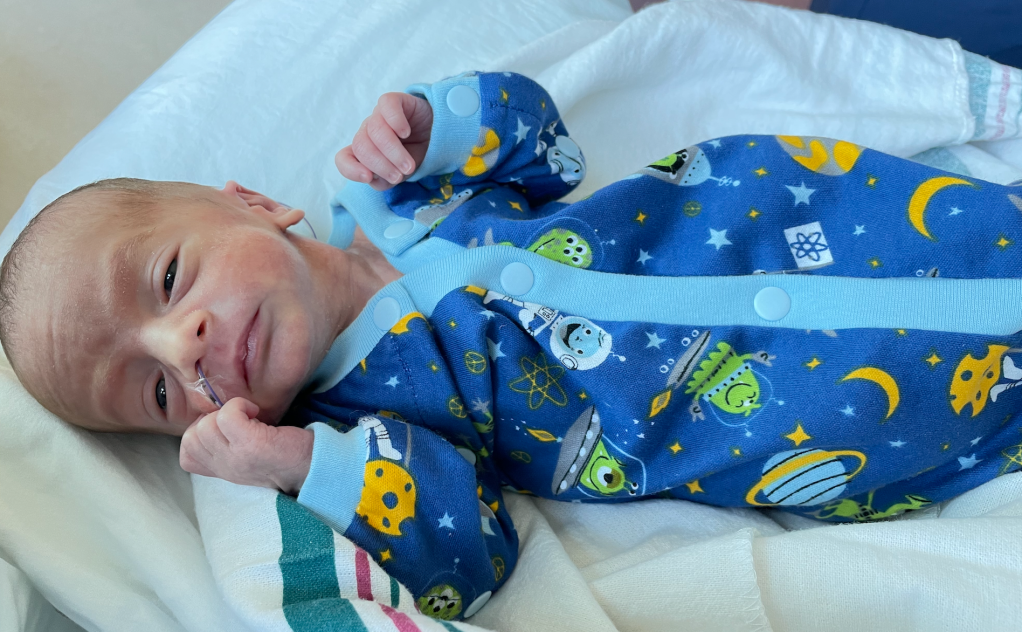
The day he got to wear clothes for the first time.
While all of these shifts were happening, Max was cared for by literally dozens of different nurses. Each shift we were greeted by a different friendly face of whichever nurse was assigned to Max for that 12-hour period, all of whom were sweet and compassionate and patient as we fumbled our way through being NICU parents. His nurses navigated the sensory overload and tension of the NICU with such grace, managing to do their jobs of providing vital healthcare and emotional support all while usually staying out of our way.
Somehow, though, Nurse Bobbie knew just when to get in our way.
We first met Nurse Bobbie on Max’s fourth day of life. The day before I had been released from the hospital and was able to finally get settled in back at home for my own recovery. The night before was the first time I went back to the hospital, walking right past the labor and delivery triage unit that I entered a week earlier ignorantly thinking I had 7 weeks of pregnancy left.
Aaron and I drove to the hospital that Wednesday morning for Max’s 8 am feeding, and as we entered his NICU room after scrubbing in we were greeted by Bobbie for the first time. She gave us the update on how his night went – he had needed to go back on nasal air flow to help him breathe, like a CPAP machine for infants (he takes after his father!) – and then helped us interact with Max because at that point he was still so tiny and fragile. Bobbie showed Aaron how to change Max’s tiny diaper and answered all of our questions about his health status and care without missing a beat. She got me situated to do skin-to-skin with Max and walked us through what to expect from his NICU stay.
Over the course of the 7 weeks Max was in the hospital, Bobbie became a beacon of light for us – I started calling her Max’s fairy godmother, but really she felt like my fairy godmother too. She showed us how to safely change, feed, and hold Max without ever once judging us for not knowing what to do, but most importantly she subtly guided us on how to feel and reminded us – again, without judgment – of when there was something to celebrate.
“Bring some onesies with you when you visit Max today – we get to put him in clothes!!” she said over the phone to me one morning a few weeks in, going out of her way to make a special call to me before I hit the road to head to the hospital. I had purchased special preemie-sized onesies because it turns out even newborn clothes are HUGE on a 3 lb baby, and had anxiously awaited the moment we could finally put them to use. When I brought Max’s tiny basket of tiny clothes to his room that day, Bobbie asked me which onesie I wanted to put him in to be his very first outfit and I completely froze. That felt like such a significant decision that I hadn’t been prepared to make – I hadn’t thought it through, hadn’t weighed the pros and cons of each option which would go down in history as “Max’s first outfit”.
As I fumbled through the tiny clothes, Bobbie could see I was overwhelmed and gently suggested “what about that cute blue one with the aliens on it?” without ever making me feel bad for taking too long to decide or not having a pre-planned outfit picked out.
“Yes – that one!” I responded, relieved to have some guidance.
“It turns out, this one is the perfect outfit to start with because it has extra snaps on the arms which will make it super easy to put on him. Excellent choice!” she validated as she showed me how to work around the various tubes and wires monitoring his vital signs.
As soon as Max was dressed, Bobbie then said to me “okay, you sit down in the armchair and bring your phone with you; I’m going to put him on this pillow on your lap so you can take pictures of him!” – I hadn’t even caught up with her enough to be excited that he was dressed for the first time because I was so steeped in the monotonous blur of the NICU routine.
Without explicitly saying it, Bobbie made it clear that this moment was something to get excited about.
I’m so glad she did, because without that reminder I think I would have missed it.
-
Mask
Skincare is my happy place.
I don’t think “the window to the soul” stops at just the eyes – to me, our entire face represents the barrier between internal and external, how we show up in the world. Which is why I love me a good face mask – and boy, have I tried them all. Doing a face mask is the ultimate act of skin-care-as-self-care for me because it requires time and intentionality. You have to do all of the right pre-mask steps (cleansing, toning), let it sit for the right amount of time, gently wash it off, and then conclude with the after care (moisturizing, then avoiding a mirror for the next hour or so until the redness goes away – hah!).
I try to do this face mask routine at least twice a week, but sometimes I get out of practice and a few weeks go by without so much as a cleanser to my face, let alone any thorough face-masking. That’s what has happened recently because, well, new baby at home. Duh. Any new parent can relate to the subtle chaos and discombobulation that accompanies having a newborn. I’m lucky if I remember to brush my teeth twice a day and my bed hasn’t been made in weeks.
Maybe because the weather has been changing and my skin has been drier than usual, it finally dawned on me that it had been a while since I’ve done a face-mask so I started to mentally gear up for this sacred self-care ritual. Even just thinking of doing a face mask made me feel “more like myself”; it’s familiar! It’s something “Old Sophie”, aka pre-parent Sophie, did! It’s something that reminds me of my values of taking time for myself and indulging in beautiful, sensational experiences! … Did I mention that I am a Taurus?!
I didn’t get much farther though, because then fear started creeping in and my organic, non GMO, cruelty free beauty product bubble burst. What if I start the face mask but then get side-tracked with the baby and forget about it and burn my face off? Something as simple as a 10 minute face mask all of the sudden started to feel overwhelming and complicated; it dawned on me that even my skincare routine would never quite feel the same as it did before having a child to care for because his needs will forever come before my wants.
By this point of my parenting journey, I am getting familiar with feeling out of control – remember, babies are the world’s greatest amplifiers and they trigger all of our existing issues. Control is definitely mine. However, this internal dialogue about my face mask sparked something new in me. Not only did it remind me how much less control over my life I have now (or at least the illusion of control), it also made me feel some grief. Grief for the independence, spontaneity, and – yes – control that I have given up to make room for this miraculous, needy little boy named Max.
Don’t get me wrong – I wouldn’t trade it back for the world. I gave it up willingly and would do it again, and got myself as mentally prepared as possible for the changes and compromises that accompany parenthood. But it turns out that it’s impossible to prepare for the tiny surprise triggers that lurk around corners or hide in skincare drawers. It’s impossible to prepare for the minute reminders of everything I gave up to make room for my child.
Turns out, there’s room for Max and room for grief too.
-
Feeling Mother
“Do you feel like a mommy yet?”
My mother-in-law has asked me this many times since I had my son, and I never really know how to answer this question. Sort of? Sometimes? I guess?
My own mom loves to tell the story of the first time she really felt like a mother: she was sitting in my pediatrician’s office for the first time filling out the intake paperwork for my first newborn appointment, and she had to specify her “relationship to the patient”; it was the first time she identified herself as “mom”.
During the week that I was hospitalized for pre-eclampsia and eventually an emergency c-section, I encountered dozens of nurses and doctors. Most of them just referred to me as “mama” when talking to me because I was one of countless patients they were caring for and it was easier than learning – or pronouncing – my name. “Sit up for me real quick, mama”; “Alright mama, we’re going to run your labs again”; “Hey mama, hold your arm out for me so I can take your blood pressure”. I liked the sound of it, but even though I was in the midst of going through very real physical experiences surrounding birth, I felt like I hadn’t earned that title yet.
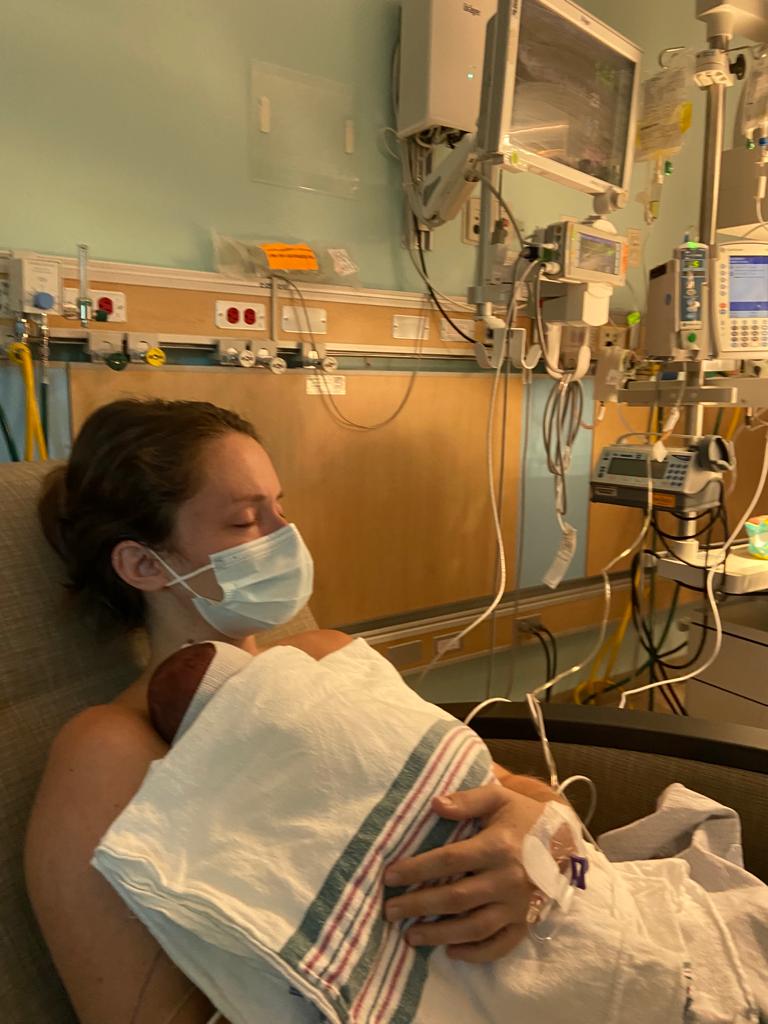
After Max was born and was admitted to the NICU, we had to announce ourselves and our relationship to the patient to the security guard in order to be allowed in. “This is Sophie Bloch, mother of Max Bloch, 235”. Even though I said that phrase hundreds of times over the 40 days he was hospitalized, it never quite rolled off my tongue.
The first time I took Max to his pediatrician, I also had to fill out my relationship to the patient on his intake forms just like my mom did for me; my heart skipped a beat in that moment because I knew it had been meaningful to my mom and her story was coming full circle with Max and I, but that role still didn’t feel real yet.
–
Today my friend invited me to a free workout class “for moms in the Jewish community” – that’s me! I counted! For the first time ever, I self-identified and opted-in as a mom; even if I didn’t know anyone else attending the class I would have at least one (okay, two) things in common with them: being Jewish, and being a mom.
After the workout class, I went by the hospital to drop off a package of premie-sized diapers that Max outgrew so they could be used for another tiny baby. As I walked into the elevator I was joined by two women who asked what floor I was going to. When I said “3rd floor please” I saw their faces light up; “oh! You too?!” I smiled and nodded, but then looked away as they carried on their conversation. I rushed ahead through the winding hallways, the muscle memory of the walk to the NICU kicking in. I arrived to the NICU waiting room and pressed the intercom to tell the security guard why I was there – “my son was in the NICU and I have some premie diapers we got from you guys that he outgrew that I’d like to give back to you if you’ll take them” – right as the two women walked in behind me. As they understood why I was there, their faces lit up again, and they started to ask me about Max and our NICU journey. I shared a little bit about our experience and, assuming they were there because of their own NICU baby, assured them that even though it’s grueling, time will pass and it will end one day – exactly what I had been told by so many others before me.
In that moment, I was the mom whose baby had been in the NICU – not the mom whose baby was in the NICU.
—–
Feeling like a mom eeks in in fits and starts, like breastmilk slowly leaking through my bra and shirt or spit-up slowly running down Max’s chin. Like the sensation in the flesh surrounding my c-section scar, the feelings of motherhood are slowly revealing themselves as a new muscle memory sets in.
Leaky boobs
Dribbling spit up
Sour breath
Grunts and groans
Bobble-head thrown about
Sharp nails clawing
Surprisingly loud sneezes
Pee squirting
Crusty nose
Subtle involuntary sleepy smiles
The rise and fall of bellies and chests pressed together and even syncing up every once in a while.
If this is what motherhood is, then I definitely feel it.
-
Baby Amplifiers
Babies are the world’s greatest amplifiers.
… and I’m not referring to the volume of their cries. “Babies are the world’s greatest amplifiers” is the insight my good friend Taylor told me a few weeks after my son was born.
“Babies bring out your pre-existing issues or quirks and make them even bigger” he said, not at all surprised to hear that I was having a hard time letting go of control.
When I had that conversation with Taylor, my son Max was already a few weeks into his NICU stay where he had been admitted for prematurity and intrauterine growth restriction – in other words, he arrived too small and too early so he needed to ride out the rest of his incubation period in the hospital under the close supervision of doctors and nurses and every type of bodily function monitor under the sun. Part of me was incredibly relieved when he was cut out of me because it meant that my body and I were no longer imminently responsible for his survival; I was off the hook for the time being at least.
At first I tried to focus on the silver lining of our situation: I was able to recover from my c-section without also being physically responsible for the care of a newborn. There was no crying baby to soothe; I could rest and sleep as much as I wanted, aside from waking up to pump every 3 hours because God forbid my milk supply wasn’t adequate enough for this 3 lb 2 oz bundle I had somehow produced. He wasn’t even able to drink it yet because he was born before babies typically develop their swallowing coordination, which left him being fed through a feeding tube for the time being. How would he even know the milk he was getting was mine?!
After the dust settled from my surgery and our parents went home, confident that I was going to be okay, that niggling desire for control started to return… hello darkness, my old friend. Every time we visited Max in the NICU, his nurses would give us an update on how he did overnight and remind us that “he’s in charge here”. There’s nothing we could do to make him grow and develop faster; we were stuck waiting for nature to take its course. There’s a reason so much infant development happens inside the womb where we can’t observe it in real-time – it’s torturous and painstakingly slow to come together, let me tell you. “Suck, swallow, breathe” had become our new mantra as we willed Max to get it together. The older he got and the closer he got to his original due date, the fewer health challenges he had aside from feeding. We were incredibly relieved that there wasn’t anything “wrong” with him, and at the same time incredibly frustrated that the one thing keeping him hospitalized was his lack of swallowing coordination – something that seemed so instinctual to us as fully grown adults.
Our daily visits with Max began with a 30 minute drive to the hospital where we’d park in the bowels of a dimly lit garage and navigate the winding hallways back to the NICU on the third floor. Once we arrived at the NICU waiting room, we buzzed in using our specially-assigned visitor code – “235, parents of Max Bloch” – and then scrubbed in at the operating-room-style industrial sinks a-la Grey’s Anatomy. Somehow this routine wasn’t quite as glamorous as when Ellen Pompeo and Patrick Dempsey do it, though. After drying and then sanitizing our hands, we were finally able to walk into Max’s room and greet him in his tiny incubator bed. Because of his need to grow and gain weight, we were only allowed to interact with Max around his feeding times so he wouldn’t burn calories unnecessarily. We’d gently change his diaper and hunker down in a plastic hospital arm chair where we’d hold him while the nurses administered his meal via feeding tube. As the weeks went on, he eventually started taking some of his feeds from a bottle with the help of a speech pathologist, incredibly patient nurses, and trial and error with countless preemie slow-flow bottle nipples. It was the ultimate case of Goldilocks: this nipple is too big, this milk is too thin, and nothing yet felt just right.
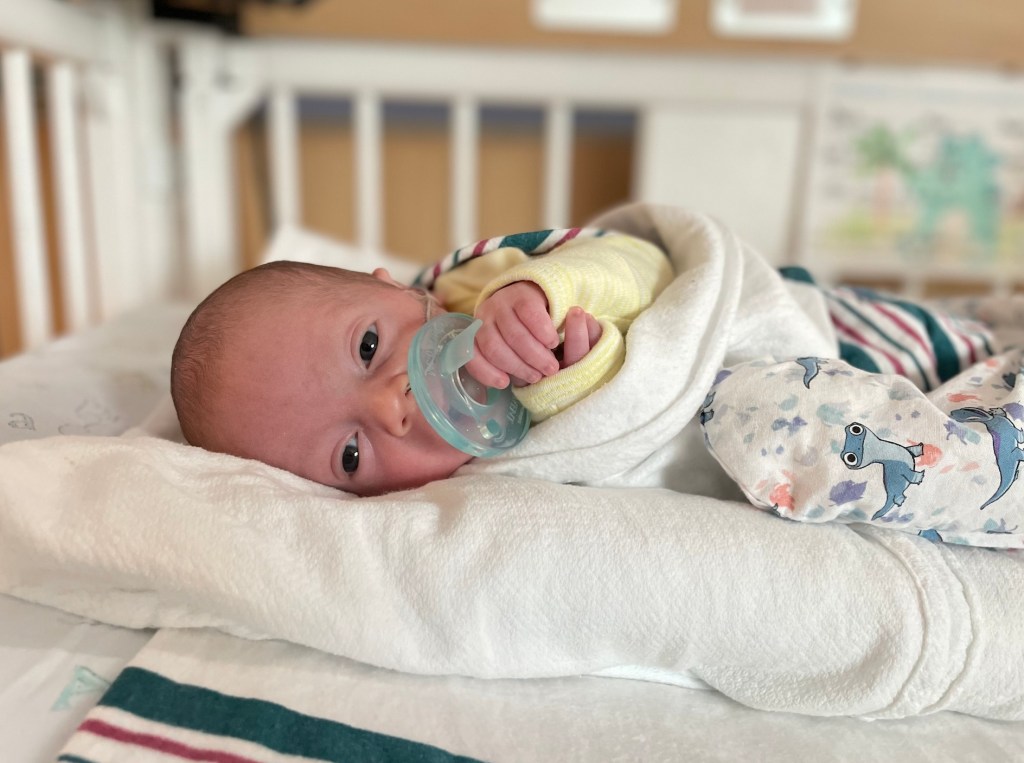
With every bottle feeding, Max practiced his “suck, swallow, breathe” coordination – and most of the time ended up choking or de-saturating which caused his heart rate and blood oxygen levels to drop. Because Max’s release from the hospital was contingent on his ability to consistently take a bottle with no issues for 16 consecutive bottles over 48 hours, every gurgle was a setback and every cough re-started the clock. A perfectly peaceful bottle would be derailed by the violent “beep, beep, beep” of the heart monitor next to Max’s bed, causing our hearts to sink and leaving us fumbling to make sure he wasn’t choking on his milk or positioned incorrectly. With so much for him to overcome, we didn’t want to be the reason Max was kept in the NICU any longer.
We started to question whether we should feed and hold and change him at all.
With so much out of our control, the one thing we COULD control was the one time a day when we were there visiting him – what if we were the cause of his coughing or choking or de-sating? Wouldn’t it be easier for us to just leave it to the nurses and stay out of the way? Couldn’t that get him out sooner? Upon facing so many unknowns, the one thing we never expected was to be afraid to hold our baby.
One night after an especially difficult hospital visit, my husband and I looked at eachother and verbalized the thought we had each secretly been thinking but too self-conscious to share: “what was the point of even having a baby? What was the point of even having a baby if we can’t even enjoy him?”
As hard as it was, we decided to ignore the hospital monitors when we visited Max from that moment on. We turned the volume off and turned the screens away, deciding to ignore the beeping and flashing lights alerts because those were all things we could not control. Instead, we talked to him and changed his diaper and switched out his onesies without worrying about what it might do to his vital signs. We focused on the things we could control: our mindset, our mood, and how we chose to spend our limited time with our son.
The ultimate act of control was in releasing control.
-
Making Meaning
The pressure was on.
I had just turned 13 years old, and was weeks away from my Bat Mitzvah where I’d stand in front of my family, friends, and community leading a Shabbat service and reading from the Torah on my own for the very first time.
I found myself at my synagogue after school – YET AGAIN – while my mom met with the caterer about the food for my Bat Mitzvah party. My sibling and I were told to wait in the big, echoey synagogue lobby where the sounds of our bickering billowed off of the 15 foot walls and sparsely furnished marble floors. Just as I was about to make another snide remark, the door to the lobby swung open with a loud “swoosh”, and our Rabbi stuck his head inside looking every which way with a distressed expression on his face. He spotted me from across the room and with a sigh of relief said “Oh! Sophie! Come with me”.
As he waved me over, I hesitantly crossed the room trying to stifle my loud clomping footsteps and considered what was going on – I wasn’t supposed to have a tutoring session then, was I? Had I forgotten about something? I was an incredibly responsible kid and took pride in following the rules, so the idea of dropping the ball on something I was supposed to be doing, while also leaving my younger sibling completely alone and vulnerable, worried me.
I barely had time to consider the ramifications of this mysterious situation because before I knew it, the Rabbi was yards ahead of me, leading me somewhere deep into the bowels of the synagogue offices. I followed him down darkly lit hallways, through a maze of rooms stuffed with dusty books and toys and stained cushioned chairs – you know the ones – until finally we arrived in a Hebrew School classroom where there were nine people sitting in a circle, mid-service.
Without explanation or introduction, the Rabbi picked up his prayer book and said to the group “please turn to page 42 for the Mourner’s Kaddish”.
At that moment, it dawned on me why I was there.
In Judaism when a loved one dies, we say the Mourner’s Kaddish or blessing twice a day for the year after their death. The unique thing about this particular blessing, unlike many others, is that it can only be said in the presence of community – it can only be said in the presence of a “minyan”, or group of 10 adult Jews. Because I had already turned 13, I “counted” as a Jewish adult even though my official coming of age celebration was still a few weeks away. The Rabbi found me in the lobby and brought me into this intimate service so the mourners there could say this prayer and continue their grieving process.
Most 13 year olds relish their Bat Mitvah party and being done with the months of intense preparation, but I realized this, here, was actually the whole point. This moment- showing up for others, especially in their time of need – is what being Jewish, being an adult, and being a Jewish adult really means. I understood the gravity of what it means to be a responsible member of a larger community. I felt like I counted, in a big way, for the first time. I didn’t know it at the time, but that was my beginning of helping others make meaning – in this case, make meaning of the loss and grief they were experiencing, just by being present for them.
–
The first time I felt the gravity of being an adult was when I was 13 counting in a minyan for mourners, and the second time I felt the same gravity was when I was 18 and made the choice to face what would end up being one of the most traumatic experiences of my life which left me as a mourner myself.
My mom and I were at a farmers market on a beautiful Saturday afternoon while I was in town for spring break my freshman year of college. We were eating a crepe with nutella and strawberries when we got a call from my Grandma: “We’re in an ambulance on our way to the hospital – they think Papa Gerry had a stroke – meet us there”.
As I walked into the emergency room waiting area shortly after, I saw my dad who had gotten there before us flag me down and start to walk me back to the room where the rest of the family was. The only thing he said to me was “they’re pulling the plug” with a shake of his head.
At that moment as we approached the patient room, I had a decision to make: I could either wait there in the hallway where I wouldn’t have to see my Papa Gerry’s body incapacitated, or I could turn the corner into his room where the rest of my family was and fully face the situation even though it would likely scar me. I turned to my mom and dad for guidance, for permission – should I go in or wait outside? They looked at eachother and looked at me, and to my surprise said “it’s up to you – you have to decide”.
Part of me knew that as painful as it was, I deserved to experience the full capacity of human emotions available to me. I believe that everything happens for a reason, and my being there physically meant that I was supposed to be there emotionally too for whatever was to come.
I turned the corner and saw something I had never imagined seeing before: my Papa Gerry – tall, athletic, strong – laying intubated in a hospital bed, his body seizing and convulsing every few seconds. The doctor explained that he had had a brain aneurysm that left him completely brain dead, and that even though his body was moving involuntarily he would never wake up.
They eventually moved him into the ICU where they took him off life support – we all agreed he wouldn’t want to stay living like this. Even though he was brain dead his body was healthy and strong. It was probably going to take a few days for his body to die so my dad, sibling and I went home while my mom and aunt stayed with my Grandma, waiting out the final stretch and promising to call us when it was time to come back and say goodbye.
The next morning I woke up to the news that overnight, my Grandma Suzy had a heart attack from the grief, called “Broken Heart Syndrome”. She had been admitted to the hospital in the middle of the night, my mom and aunt alternating between being with my grandma in the ER and with my grandpa in the ICU.
At the only moment during the entire time he’d been in the hospital that both of his daughters were out of the room – the moment when the doctors told my mom and aunt that my grandma would survive her heart attack – Papa Gerry died. Even though he was brain dead, even though the doctors expected it to take days, he somehow waited to know that my grandma would be okay and for his daughters to be spared from watching their father flatline.
I later found out that a few weeks before he died, Papa Gerry got diagnosed with a rare but serious lung condition that would have caused him a slow and painful death. He was so afraid of his body giving out on him, of having to give up the things he loved like his daily workouts and squash games, of shrinking away before our eyes eventually becoming wheelchair bound and bed ridden. The fact that he had a massive brain aneurysm days after getting diagnosed – a death that was far less painful for him, albeit painful for the rest of us – and the fact that his body died right when we knew Grandma Suzy would live – to me felt meaningful.
In the week that followed, my family underwent our own grieving process. We grieved over the loss of my grandfather, all while my grandmother recovered from her heart attack in the exact same ICU room where my grandfather died mere hours earlier. We said the Mourner’s Kaddish – the same prayer my presence in that tiny service all those years ago enabled others to say – surrounded by our loved ones as we tried to make meaning of his death.
—
I have since realized that my purpose in life is to make meaning. It’s what drives me.
That’s because meaning leads to understanding, and understanding leads to value.
My biggest fear in life is to be misunderstood. I’ve felt misunderstood as an introvert, as a mature kid who preferred to hang out with adults instead of my own peers, as an older sibling to a person who was way different than me, and as the spouse of a doctor going through residency.
I’ve discovered that I feel most understood when I’m able to express myself in an authentic way and intentionally articulate who I am. I’m able to express myself authentically and with articulation when I make meaning of myself, my experiences, and my relationships.
Meaning leads to understanding, and understanding leads to value. When we make meaning out of our experiences, we access their deeper value.
The process of meaning making begins with your mindset: Choosing to believe that everything happens for a reason. Buying into that mindset opens you up to see patterns and purpose in your experiences that you otherwise wouldn’t be able to see.
It continues with self-awareness. Zooming out and without judgment noticing patterns, trends, and themes that arise in our experiences. This self-awareness empowers us to take control over our reactions to what we experience, and then create new ones.
Finally, making meaning occurs when we take authentic ownership: Putting words to our patterns, naming them, explaining them to others and claiming them fully.
When we make meaning, we can express ourselves with intention, articulation, and authenticity.
When we fully express ourselves, we feel understood.
When we feel understood, we feel valued.
And feeling valued enables us to see the inherent value in others.

