Babies are the world’s greatest amplifiers.
… and I’m not referring to the volume of their cries. “Babies are the world’s greatest amplifiers” is the insight my good friend Taylor told me a few weeks after my son was born.
“Babies bring out your pre-existing issues or quirks and make them even bigger” he said, not at all surprised to hear that I was having a hard time letting go of control.
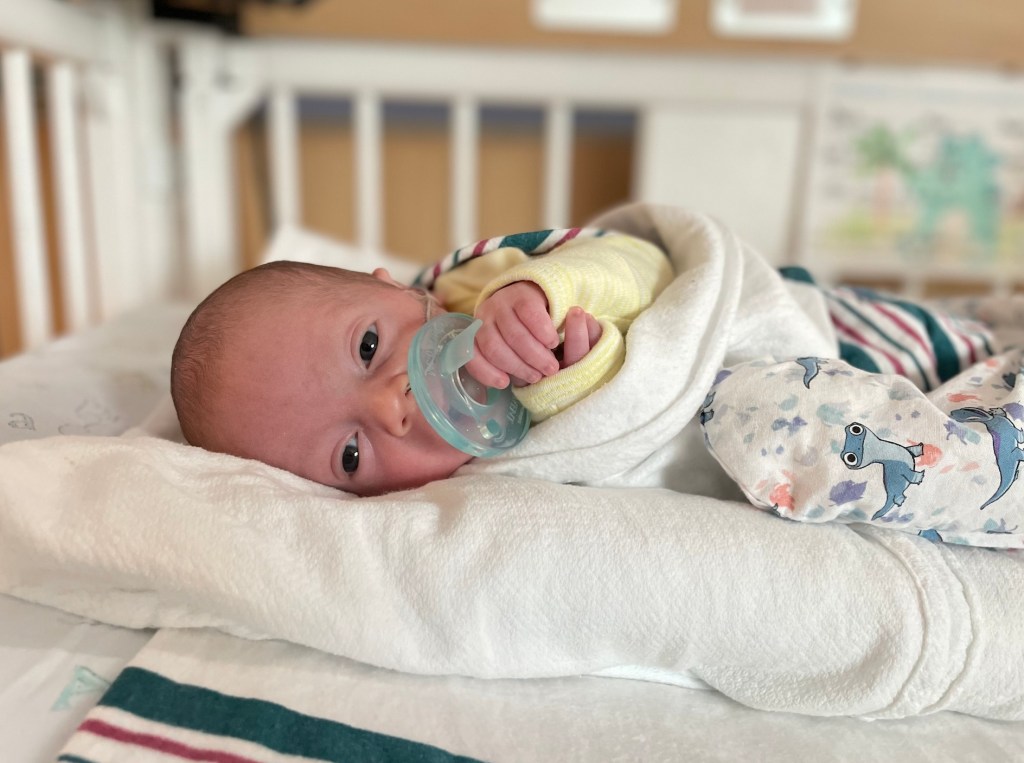
When I had that conversation with Taylor, my son Max was already a few weeks into his NICU stay where he had been admitted for prematurity and intrauterine growth restriction – in other words, he arrived too small and too early so he needed to ride out the rest of his incubation period in the hospital under the close supervision of doctors and nurses and every type of bodily function monitor under the sun. Part of me was incredibly relieved when he was cut out of me because it meant that my body and I were no longer imminently responsible for his survival; I was off the hook for the time being at least.
At first I tried to focus on the silver lining of our situation: I was able to recover from my c-section without also being physically responsible for the care of a newborn. There was no crying baby to soothe; I could rest and sleep as much as I wanted, aside from waking up to pump every 3 hours because God forbid my milk supply wasn’t adequate enough for this 3 lb 2 oz bundle I had somehow produced. He wasn’t even able to drink it yet because he was born before babies typically develop their swallowing coordination, which left him being fed through a feeding tube for the time being. How would he even know the milk he was getting was mine?!
After the dust settled from my surgery and our parents went home, confident that I was going to be okay, that niggling desire for control started to return… hello darkness, my old friend. Every time we visited Max in the NICU, his nurses would give us an update on how he did overnight and remind us that “he’s in charge here”. There’s nothing we could do to make him grow and develop faster; we were stuck waiting for nature to take its course. There’s a reason so much infant development happens inside the womb where we can’t observe it in real-time – it’s torturous and painstakingly slow to come together, let me tell you. “Suck, swallow, breathe” had become our new mantra as we willed Max to get it together. The older he got and the closer he got to his original due date, the fewer health challenges he had aside from feeding. We were incredibly relieved that there wasn’t anything “wrong” with him, and at the same time incredibly frustrated that the one thing keeping him hospitalized was his lack of swallowing coordination – something that seemed so instinctual to us as fully grown adults.
Our daily visits with Max began with a 30 minute drive to the hospital where we’d park in the bowels of a dimly lit garage and navigate the winding hallways back to the NICU on the third floor. Once we arrived at the NICU waiting room, we buzzed in using our specially-assigned visitor code – “235, parents of Max Bloch” – and then scrubbed in at the operating-room-style industrial sinks a-la Grey’s Anatomy. Somehow this routine wasn’t quite as glamorous as when Ellen Pompeo and Patrick Dempsey do it, though. After drying and then sanitizing our hands, we were finally able to walk into Max’s room and greet him in his tiny incubator bed. Because of his need to grow and gain weight, we were only allowed to interact with Max around his feeding times so he wouldn’t burn calories unnecessarily. We’d gently change his diaper and hunker down in a plastic hospital arm chair where we’d hold him while the nurses administered his meal via feeding tube. As the weeks went on, he eventually started taking some of his feeds from a bottle with the help of a speech pathologist, incredibly patient nurses, and trial and error with countless preemie slow-flow bottle nipples. It was the ultimate case of Goldilocks: this nipple is too big, this milk is too thin, and nothing yet felt just right.
With every bottle feeding, Max practiced his “suck, swallow, breathe” coordination – and most of the time ended up choking or de-saturating which caused his heart rate and blood oxygen levels to drop. Because Max’s release from the hospital was contingent on his ability to consistently take a bottle with no issues for 16 consecutive bottles over 48 hours, every gurgle was a setback and every cough re-started the clock. A perfectly peaceful bottle would be derailed by the violent “beep, beep, beep” of the heart monitor next to Max’s bed, causing our hearts to sink and leaving us fumbling to make sure he wasn’t choking on his milk or positioned incorrectly. With so much for him to overcome, we didn’t want to be the reason Max was kept in the NICU any longer.
We started to question whether we should feed and hold and change him at all.
With so much out of our control, the one thing we COULD control was the one time a day when we were there visiting him – what if we were the cause of his coughing or choking or de-sating? Wouldn’t it be easier for us to just leave it to the nurses and stay out of the way? Couldn’t that get him out sooner? Upon facing so many unknowns, the one thing we never expected was to be afraid to hold our baby.
One night after an especially difficult hospital visit, my husband and I looked at eachother and verbalized the thought we had each secretly been thinking but too self-conscious to share: “what was the point of even having a baby? What was the point of even having a baby if we can’t even enjoy him?”
As hard as it was, we decided to ignore the hospital monitors when we visited Max from that moment on. We turned the volume off and turned the screens away, deciding to ignore the beeping and flashing lights alerts because those were all things we could not control. Instead, we talked to him and changed his diaper and switched out his onesies without worrying about what it might do to his vital signs. We focused on the things we could control: our mindset, our mood, and how we chose to spend our limited time with our son.
The ultimate act of control was in releasing control.

Leave a comment